Welcome to Natasha Tontey
The Phantom Combatants and the Metabolism of Disobedient Organs is a newly commissioned multimedia installation by Natasha Tontey, presented at Ateneo Veneto, a sixteenth-century academy of science, literature and the arts.
Introduction
The work reimagines the story of Len Karamoy, a female combatant in Permesta, a political movement that opposed the Indonesian government in the late 1950s. In Tontey’s retelling, Karamoy is not a single historical figure but a mythic presence, multiplied into the Phantom Combatants through a chorus of young troops.
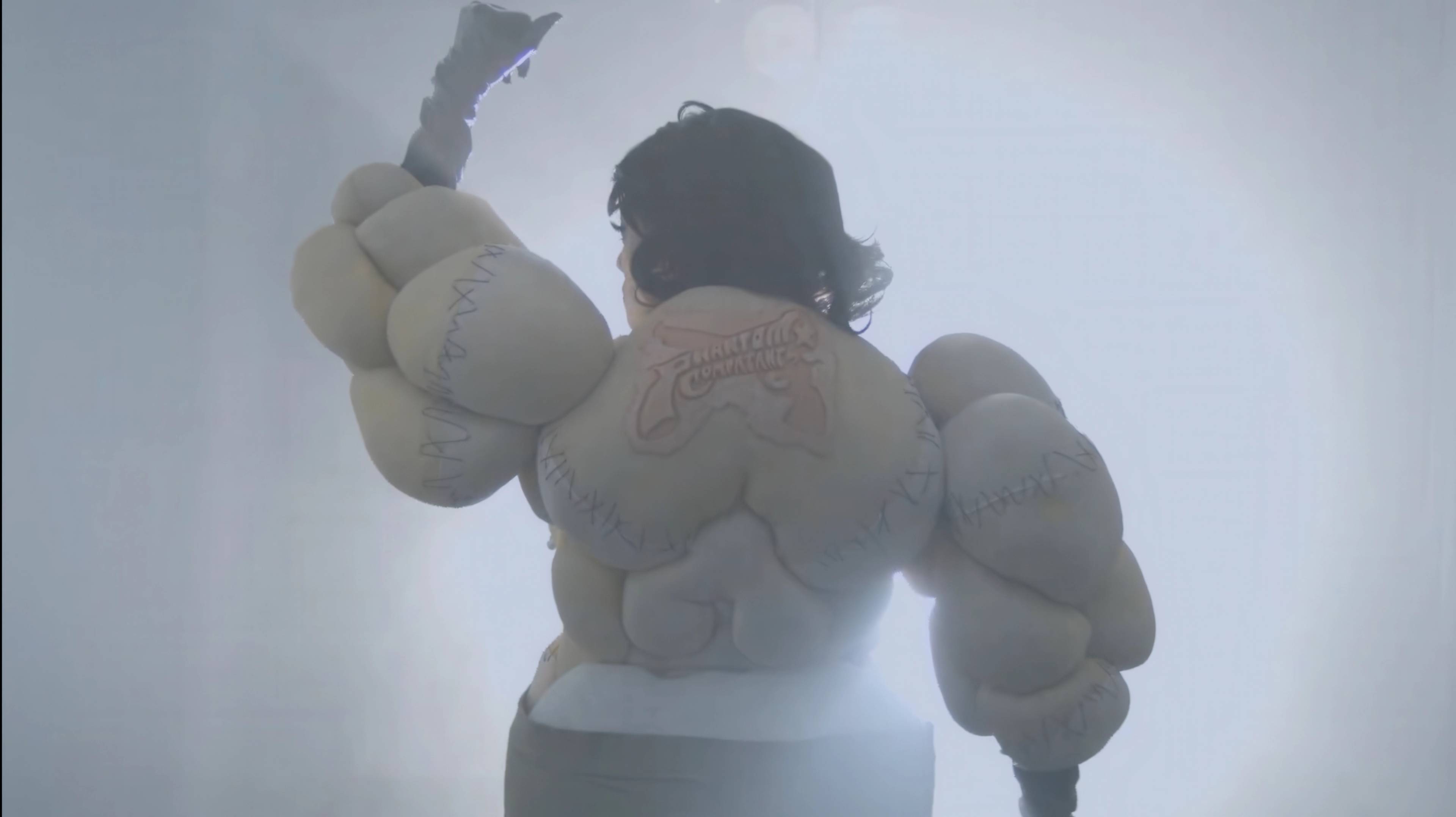
"The work follows a female resistance figure who slips between history, rumour and myth." – Natasha Tontey
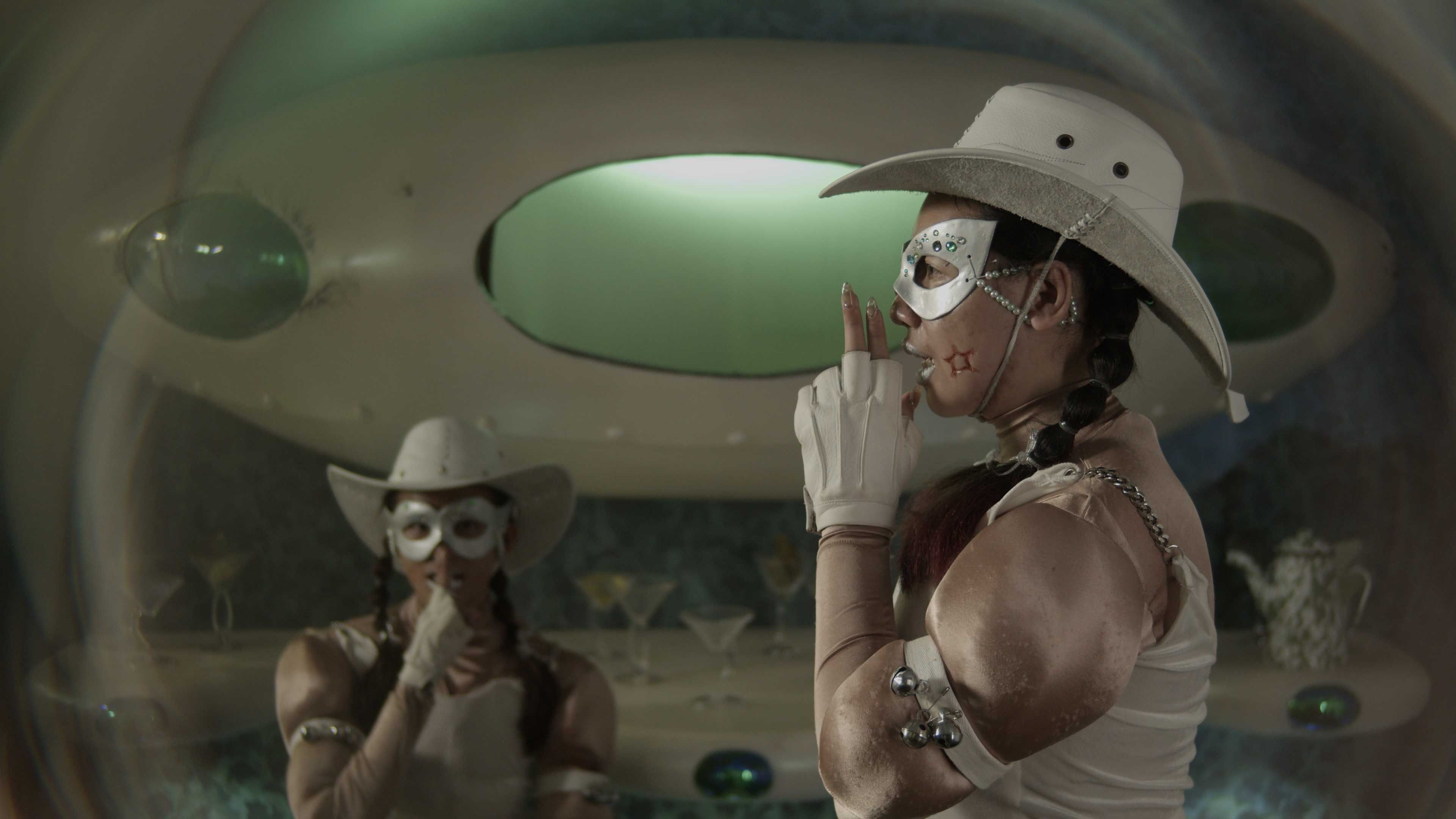
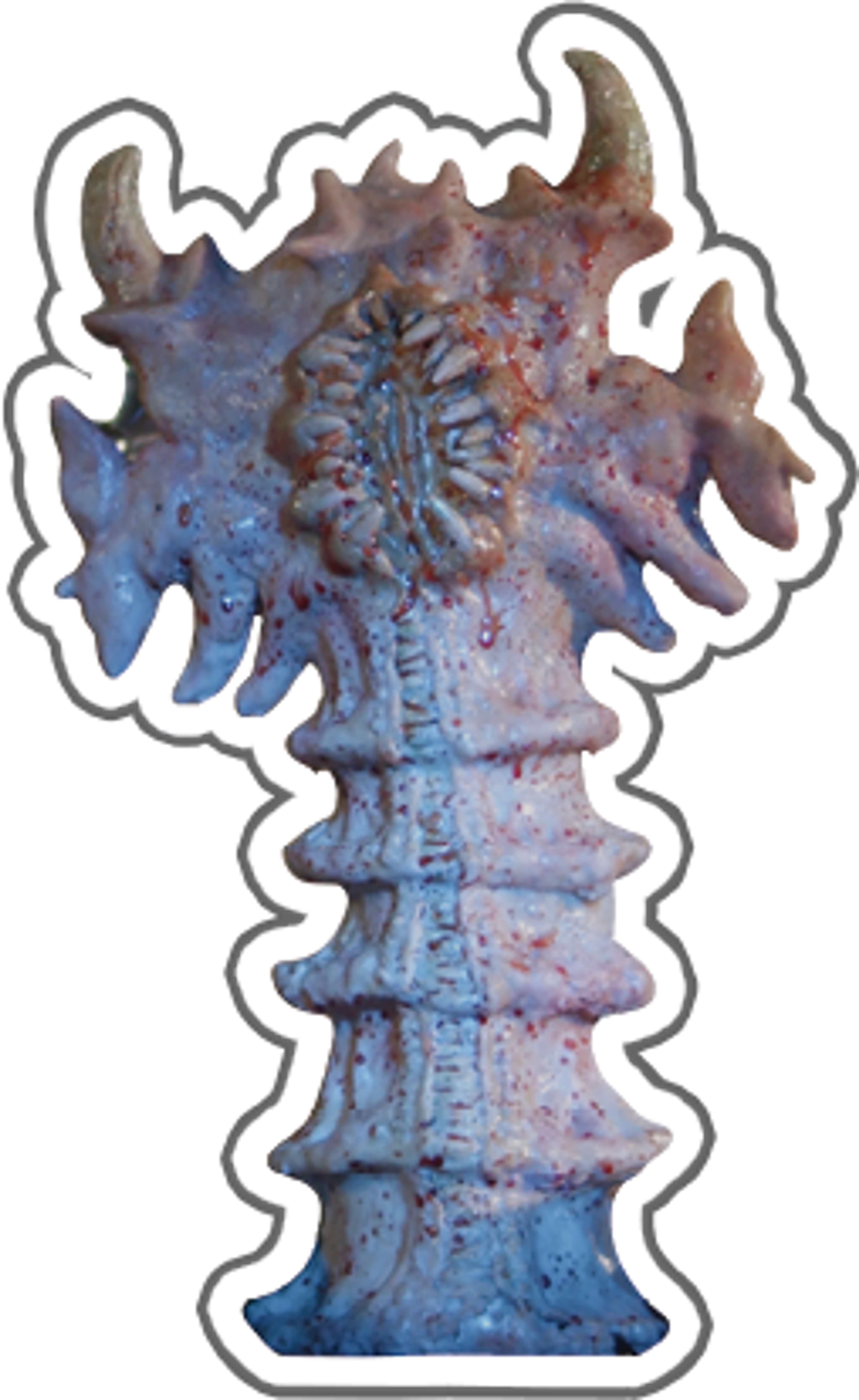
The story unfolds through a fragmented video installation. It combines the campy aesthetics of B-movies with CGI and imaging technologies. These include the latest quantum ghost imaging tool which uses photons to produce images, the remote sensing method LiDAR (Light Detection and Ranging), as well as 3-D modelling photogrammetry techniques and thermal cameras — invoking the ways bodies and territories are measured, mapped and militarised. Featuring highly stylised costumes and props, the work delves into moments of heightened theatricality, complemented by playful and inventive editing techniques. Key props were reworked into a sculpture which expands the video’s material language into the installation.
In the installation designed by Giulia Foscari, UNA / UNLESS, a ramp winds around the space, loosely referencing the circles of hell in Dante’s Inferno. This journey brings us unusually close to Jacopo Palma il Giovane’s paintings titled Cycle of Purgatory (1600) installed in the coffered ceiling, illuminated in red by Tontey. The paintings’ depiction of souls in limbo resonates with The Phantom Combatants’ exploration of unresolved political struggle. The mirrored floor reflects the paintings and Tontey’s imagery, creating an interplay of mythic figures suspended outside of time.
Marking the third instalment in Tontey’s Macho Mystic Meltdown (2025–26) anthology, The Phantom Combatants foregrounds feminist and Indigenous perspectives in rethinking resistance. The work makes a timely appeal for autonomy and self-determination, asking us to reconsider sovereignty — not only of territory and knowledge, but of the body itself — in a world where all three remain sites of contested power. Natasha Tontey: The Phantom Combatants and the Metabolism of Disobedient Organs (2026) is a joint commission between LAS Art Foundation (Berlin) and Amos Rex (Helsinki) presented on the occasion of the Biennale di Venezia — 61st International Art Exhibition.
Plot Line
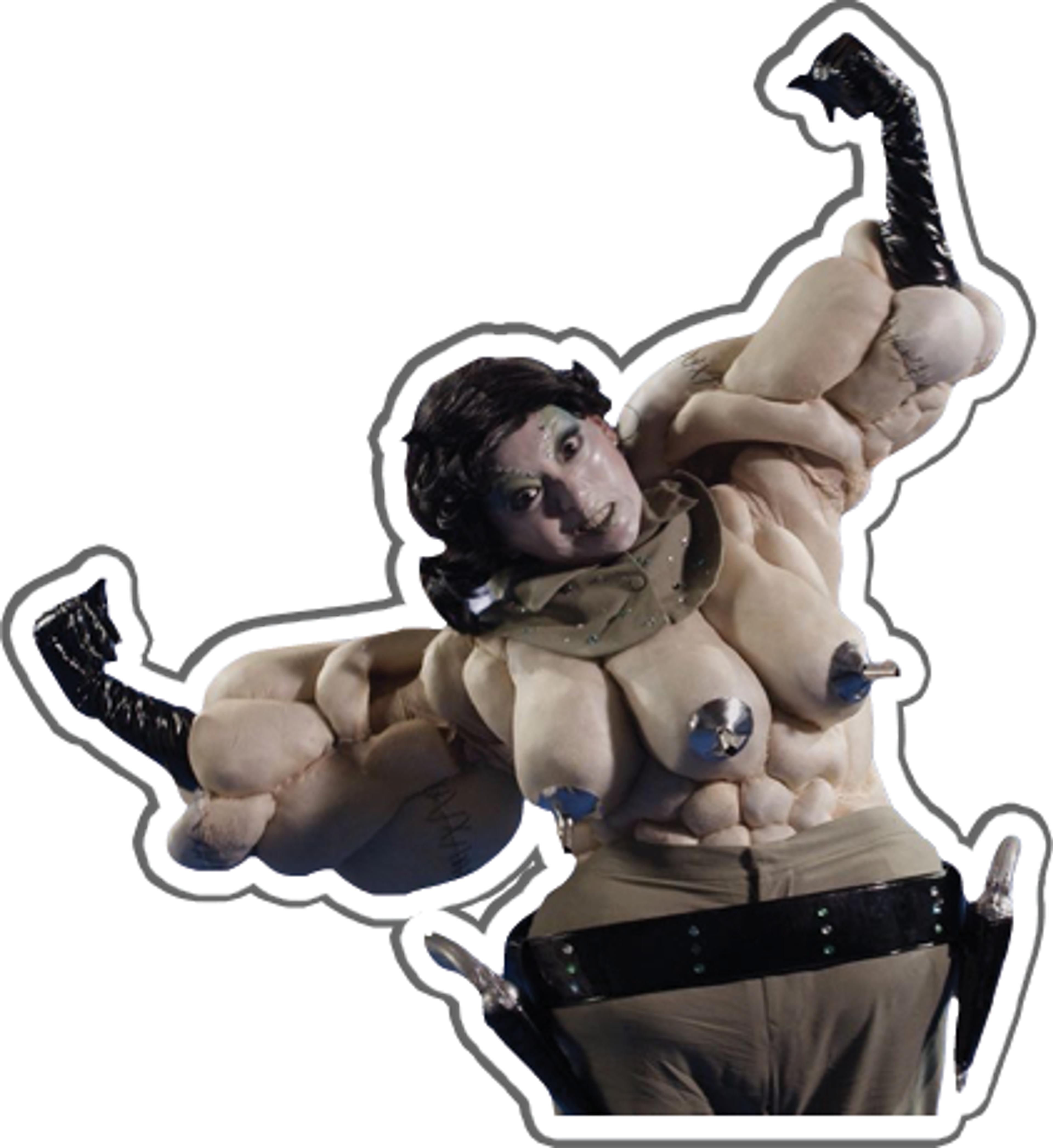
The video is a work of speculative fiction based on Minahasan female rebel soldier Len Karamoy, who fought in the Permesta movement against the centralised rule of the Indonesian government from 1957 to 1961. Set deep in Minahasan territory in Cold War-era North Sulawesi, the video opens with a sweeping pan across the fields beneath Mount Lokon as plumes of volcanic smoke drift across the sky at dawn. Over this trembling landscape we hear the voice of Len Karamoy, a.k.a. the Phantom Combatant, a three-breasted, hypermuscular resistance fighter. She recounts how the government treated both land and peoples as extractable resources in the process of building nationhood.
The Phantom Combatant describes how the resistance movement was betrayed by its own: Jan Timbuleng, leader of Battalion 999 and Karamoy’s ex-lover. In a flashback scene, we are introduced to seven masked girl warriors training at Permesta headquarters, a space-age salon. Timbuleng forms his own radicalised faction that weakens Permesta. When the betrayal is revealed, the Combatant erupts in rage and, guns blazing, attacks Timbuleng. Wounded but alive, he is captured and must await his punishment.

The troops ride ponies through a forest at dawn and encounter a mystical training ground overseen by an elder shaman dressed in a cape with skulls and wielding a staff. Guided by the shaman, they channel ancestral energies to fertilise the combatant, whose body mutates rapidly as her pregnancy accelerates. The shaman performs a ritual with steamed medicinal herbs and guides her as she gives birth to a beam of light shooting through a singing vagina dentata. The light then darts into a teapot that contains the HQ where Timbuleng is imprisoned. There the troops deliver justice by cutting off the traitor’s ears. Afterwards, the shaman pours the contents of the teapot back into the world, where the combatants charge into the shaman’s cape, now transformed into a projection canvas showing black-and-white fighter planes and a skywriter spelling out the word “OTONOMIA” (AUTONOMY). The epilogue reveals Timbuleng defeated and earless, with “I YAYAT U SANTI. 999” (RAISE YOUR SWORD) tattooed on the inside of his lower lip. The story ends with a call to keep the fight for autonomy alive.

Reading Notes
The Minahasans (or Minahassa) are an Indigenous group from the Minahasa Peninsula in North Sulawesi, Indonesia. Their world-view is rooted in animism and a symbiotic relationship with nature, shaped by kinship, reciprocity and non-anthropocentric understandings of the world. The manguni (owl) is a Minahasan emblem of wisdom, guardianship and divine guidance, appearing on a sling in Tontey’s video.
The wali’an sekad (shaman’s ritual staff) represents ancestral and spiritual authority.
The yaki (macaque) skulls worn by the wali’an are used in war rituals and symbolise the warrior spirit of the Minahasan people.

Bakera (steam bowl) is used for steam inhalation with leaves, roots and spices in Minahasan healing and purification rituals guided by a wali’an. In Tontey’s video, the bakera ritual takes on psychoactive effects, chemically enhancing the combatants.

Permesta was a political movement in North Sulawesi that opposed the centralised rule of the Indonesian government from 1957 to 1961, receiving support from the CIA during the Cold War. The name Permesta derives from Perjuangan Semesta, meaning “universal struggle.” Echoing this spirit of resistance, “I YAYAT U SANTI” — a tattoo seen inside Jan Timbuleng’s lower lip in the video — is a Minahasan war cry and phrase celebrating bravery that roughly translates to “raise your sword.”
Purgatory is a liminal realm in Christian belief where souls undergo judgment and purification before moving on to either heaven or hell. Tontey evokes this concept at Ateneo Veneto, bringing visitors close to Jacopo Palma il Giovane’s paintings titled Cycle of Purgatory (1600). The teapot in her video functions as a similar purgatorial space: a suspended realm where Jan Timbuleng is held to account for his betrayal. Within this vessel, justice unfolds in ways history never recorded, before the characters are finally poured back into the world. This scene reflects Tontey’s speculative fiction approach, drawing on the logic of shows like The Twilight Zone where surreal spaces open to reimagine unresolved histories and moral reckonings.

Xenofeminism is a branch of feminist thought that rejects “nature” as a fixed category and argues for the use of technology to abolish gender-based oppression. Xenofeminism envisions liberation through hacking, transformation and looking to “alien” futures rather than return to any essential origin. The concept was conceived by the Laboria Cuboniks collective in the spirit of their manifesto’s “call to action”: “If nature is unjust, change nature!” Tontey’s work embraces a xenofeminist approach, using technology, transformation and multiplicity to queer gendered performance. Her characters and symbolic motifs reimagine power by reclaiming “monstrous” forms and celebrating excess, collectivity and defiance.

Multi-breasted figures and other multiples appear throughout the work, as characters and organs amplify forms of female agency and wisdom. The Phantom Combatant is three-breasted; the girl warriors move as a pack of seven; and the elder shaman appears as a four-breasted manifestation of cosmic insight. Tontey blurs the boundaries between human and non-human: her multiple breasts hint at the physiology of other mammals, while pistol heads embedded within them mark the Phantom Combatant as a cyborg. Across the work, the motif of multiples also operates as a symbol of collectivity and interconnectedness. This resonates with Minahasan cosmology, where the concept of trinity is long-standing: Minahasans believe in a single, high god articulated through a trinitarian structure shaped by Christianity.
Vagina dentata, the myth of the toothed vagina, features widely in many cultures. The myth builds on the concept of the female body being inherently monstrous, and has historically often functioned as a cautionary tale about the perils of female sexuality. In many traditions, this story served specifically as a deterrent against men attempting to violate women, recasting the aggressor as the one who encounters danger instead of the victim. Its presence within Tontey’s video reflects the weaponisation of bodies, particularly given that sexual violence is a common instrument in conflict, while reclaiming this myth as a symbol of resistance to patriarchy.
Biographies
02

Credits
Natasha Tontey: The Phantom Combatants and the Metabolism of Disobedient Organs
Commissioned by LAS Art Foundation and Amos Rex
Artist Credits
Video Credits
Artistic Department
Cinematography
Lighting
On Location Sound
Post-Production: Sound
Post-Production: Visual
Post-Production: Accessibility
Unit
Location
LAS and Amos Rex Project Team
Installation Team
Thank you:
LAS team, Amos Rex team, Sohei Yasui, Anna Iso-Ahola, Noora Nuotio, Ziyi Pei, Alina Fichtner, Marielle Jaquier, Matilde Nuzzo, Saara Reiman (Kaiao)
The artist thanks:
The late Brigitte Montolalu (d. 2025, Jakarta, Indonesia), Riar Rizaldi, Jeremy David Montolalu, Pieter Santi Waraney Montolalu, Family of the late Jan Timbuleng, Emmy Kartini Timbuleng, Family of the late Len Karamoy and Daan Karamoy, Reney Karamoy & Stella Gareth, Cici Karamoy & Revly Karamoy, The late Laurens Sarapung (Battalyon Jin Kasuang) (d. 2025, Tondano, Minahasa), Manimporok Dotulong, The late Boeng Dotulong ‘Tua Lokon’ (d. 2026, Arnhem, the Netherlands), Eddie Pakasi (Corps Tentara Pelajar Permesta), Mawale Movement, Wale Papendangan Sonder, PUKKAT (Pusat Kajian Kebudayaan Indonesia Timur), Rikson Childwan Karundeng, Pdt. Ruth Ketsia Wangkai Denni Pinontoan, Yayasan Kebudayaan Minahasa Jakarta, The Late Winny Wenas-Pakasi (d. 2024, Jakarta, Indonesia), Tonaas Grevit Toalu, Tonaas Rinto Taroreh, The Late Tonaas Annie Wowor (d. 2023, Tompaso Baru, South Minahasa), Kieran Long, Bettina Kames, Flinder Zuyderhoff-Gray, Carly Whitefield, Itha O’Neill, Zoe Buechtemann, Alexis Convento, Antonella Perna, Christine Langinauer, Kawasaran Wulan Lengkoan, Junita Kesek & Septian R. W. Lolowang, Iwan Kewas & Marni Kojo, Christian Singon & Debby Mangindaan, Melky Sambow & Jeany Wowor, Herry Rompas, Koutje Sumarandak, Eno Kamasi, Wenda Tewu, Wale Walanda (Octa Kandouw), Gerda Sumampouw-Paath, Amphitheater Woloan, Yama Resort, D’88 Resort, Rinto Rais, Rimbun Air, Tamaska Hijau, Sabrina Mellisa Montolalu, Penceng “Simak Studio Kreasi”, Transmission from the other world, Ancestral signal, still transmitting — Len Karamoy (8 August 1934 – 22 June 1968)
With care and compassion — I Yayat U Santi!